Tuesday, 11 July 2017
Chronicles from Rome | My 5 Favorite Fountains in the Eternal City
Rome has fifty monumental fountains and hundreds of smaller fountains, bringing freshness to the streets and squares and water to its inhabitants and visitors. With over 2000 fountains in all, the Eternal City has more fountains than any other city in the world. Today I'll bring you just a hand full of my favorite ones, conscient that this is an unfinished work.
FONTANA DI TREVI
The Fontana di Trevi is perhaps one of the most emblematic and well-known fountains of Rome. Who has not seen the scene of the movie La Dolce Vita by Fellini, in which Anita Ekberg enters the fountain and invites Marcello Mastroianni to follow her?
Despite its grandeur and drama, the Trevi Fountain sits on a relatively small square (actually it is the crossroads of three streets (tre vie)!), where almost all the tourists who want to visit it hardly fit. In spite of the turmoil, of the policemen who whistle when one approaches too much of the water and the queues to take a photo or to throw a coin in the basin, the fountain is splendid, with its tritons and sea horses, that seem to want to jump from the basin, ready to gallop ahead!
FONTANA DELLE TARTARUGHE
The Fontana delle Tartarughe it's a beautiful fountain, in a quiet little square (Piazza Mattei). It has a curious history since it was not built in the place where it had initially been planned. On the other hand, the turtles that give it its name are not part of the initial design and were added decades later, during a restoration.
FONTANA DEI QUATTRO FIUME
Located in Piazza Navona, it represents the four main continents of the world and the great rivers that cross them: the Nile River in Africa, the Ganges River in Asia, the Danube River in Europe and the Rio de la Plata in America (the It has not been discovered!).
The lively Piazza Navona is one of the most well-known squares of Rome and it has a rectangular shape since it was originally a Roman stadium. Over time, the houses were built on the benches, and by the end of the fifteenth century it was characterized as a square. In the seventeenth century, the Fontana dei Quattro Fiume was built, following the Bernini project, in the center of the square and today it is one of its main focuses of attention.
FONTANA DEL PANTHEON
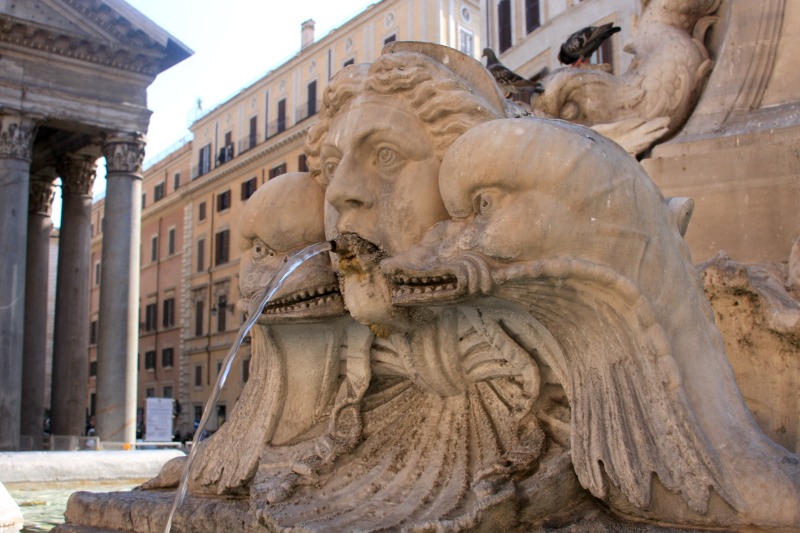
The Fontana del Pantheon can be found in Piazza della Rotonda, in front of the Pantheon. This is another beautiful fountain, from the last quartile of the 16th century, surmounted by an obelisk, which refreshes and fills with its crystalline sound this busy square.
The Piazza della Rotonda is one of Rome's busiest places, either during the day or at night, when its restaurants and terraces fill with visitors. The fountain is a central motive of attraction, only losing prominence for the imposing Pantheon that, after having been built by Agrippa, was, after its destruction, ordered to be rebuilt by Emperor Hadrian, in order to erect a temple to all the gods, both from Rome and from the conquered territories.
FONTANA DELLA BARCACCIA
The Fontana della Barcaccia is a singular fountain situated at Piazza di Spagna close to the Spanish Steps. The fountain was built with the shape of a half-sunken ship with water overflowing its sides into a small basin. Its unusual shape is probably due to an old legend that may have inspired Bernini to whom the design of the fountain was commissioned. According to the legend, when the Tiber River flooded, the water carried a small boat into the Piazza di Spagna that stayed in the center of the square after the water receded.
Labels:
Italy,
Rome,
Travel,
Travel Tips
Location:
Rome, Metropolitan City of Rome, Italy
Wednesday, 5 July 2017
Wine Chronicles | Wine Sunset Party and a Cruise on Sado River
Sunset parties became a hit these last few years. Add to that some great wine and food, music, good company while cruising along the beautiful shores of Arrábida, in Portugal, and you will have some very well spend hours.
Last Saturday, I was invited by Sado Arrábida for one of its wine cruises, departing from Setúbal. The 2 and a half hours cruise starts late in the afternoon and its a real sunset party with DJ on board, a nice sun deck to relax (or dance), great regional food and a wine tasting from some of the best regional wine producer.
The city of Setúbal is less than an hour away from Lisbon, going South, and visiting it and the Arrábida region can be a great day trip from the Portuguese capital. This Wine Sunset Party can be a perfect way to end up your day before returning to Lisbon. The ship crosses de river Sado to Tróia peninsula and then sales close to Arrábida coast before returning to Setúbal.
During the party, food and drinks are served and we had the opportunity to taste some delicious regional cheese, charcuteries, and bread, seasonal fruits like grapes and cherries were also available. The wine tasting, held by the winery Venâncio Costa Lima presented 4 wines: a refreshing white -Vale Pereiro (Fernão Pires, Setúbal Muscat), an innovative red - 4ª Geração (Castelão, Syrah), a sweet Moscatel de Setúbal - Moscatel de Setúbal 2013 (Setúbal's Muscat), and my favorite - Moscatel Roxo 2013 (check all the information below). Not long since this tasting, Moscatel Roxo 2013 as winning the award for the Best Muscat Wine in the World. Congrats Venâncio Costa Lima Winery!
Cruising along the Arrábida coast we can see small white sand beaches and coves and several historical buildings. Some of the more striking views are from the Fort of Santiago and Palácio da Comenda. The Fort of Santiago can have its origins in a Roman temple dedicated to Neptune that stayed in the same place. The first historical reference, however, dates to 1390 and can be found in an order of King D. João I to build an inshore watchtower. Over the centuries, it was expanded and remodeled and in the 20th century, after being jail and vacation home of the royal family, the fort was given to Queen D. Amelia for installing there a sanatorium.
Closer to Setúbal the graceful Palácio da Comenda catches our eyes. The volumetric of the building, the pale yellow walls, the contrast of the bougainvillea flowers on the porch, all combines with the woods surrounding the building. The stories around the palace, built in the beginning of the 20th century and currently abandoned, are immense and some famous visitors to the house are usually named. It's the case of Jacqueline Kennedy that is supposed to have been a guest to Palácio da Comenda, in 1963 after the assassination of President Kennedy and of Truman Capote the famous American writer.
On our trip we also had the opportunity to take a good look at the Portuguese Navy's ship "Creoula", a four-masts lugger, built in 1937, to sail as a cod fishing ship in the icy seas of Newfoundland and Greenland. Currently is a training ship, with the purpose of fostering young people's attachment to the sea.
After two hours, the sun was setting behind the hills and we head back to Setúbal. After a few glasses of wine, the spirits were high and everyone was in a good mood. People dancing and laughing while sipping the last glass of wine were the picture of a well spent afternoon. Just one thing was missing to be perfect. 99% of the times, a group of dolphins follows the ship, jumping and playing in the water. This time, we were among the unhappy 1% that are not fortunate to enjoy their appearance. If I needed any excuse to come back to Sado river, this seems to be a very plausible one to me.
These Wine Sunset Parties are organized by Sado Arrábida and the Wine Route of Setúbal's Peninsula and take place every Saturday from June to September. Start at 18:30 and end at 21:00.
Wine Sunset Party
Information and Reservations:
Cell Phone: (+351) 915 560 342
E-mail: geral@SadoArrabida.pt
Site: www.SadoArrabida.pt
Monday, 3 July 2017
Almada Negreiros Lisbon Itinerary | Igreja de Fátima
The Church of Our Lady of the Rosary of Fatima (usually known as Igreja de Fátima) is located in Avenidas Novas district in Lisbon, the modernist neighborhood of the city developed in the first half of the 20th century. This is also one of my favorite churches in the city (along with Lisbon Cathedral) and one that is particularly dear to me.
The church was commissioned in 1933 to the architect Porfírio Pardal Monteiro and is a remarkable work of Portuguese modernism, with the particularity of being the first Catholic temple to be built in Lisbon after the implantation of the Republic (1910).
The building's exterior, where straight lines and pure forms prevail is composed by a large volume, forming the main nave, covered with a flat roof terrace, which articulates with the lower volumes of the two side aisles, and also with the baptistery and the unique and asymmetrical tower on the façade. The traces of art deco are patented in the asymmetry and fragmentation of volumes and in the way they are ornamented.
Like many other works of Pardal Monteiro, the building had the artistic collaboration of Almada Negreiros (stained glass) and of other Portuguese sculptors and artists. The works of Almada Negreiros in the Baptistery are particularly impressive, and the stained glass behind the alter is absolutely breathtaking. Although this church is a little off the beaten path, its beauty and artistic value totally recommend its visit.
Almada Negreiros's works in this church include the stained glass of the "Holy Trinity" in the Choir, the stained glass, mosaics and doors of the Baptistery, the stained glass "Calvary" and "Our Lady of Mercy" in the Chapel of Our Lady of Mercy, the stained glass "Our Lady of Carmo" and "Queen of Christians" in the Chapel of Our Lady of Carmo, and the stained glass and Eucharistic symbols of the canopy of the Apse. In the Apse, the four frescoes of the "Evangelists", were also painted by Almada Negreiros.
Igreja de Nossa Senhora do Rosário de Fátima
Av. de Berna 26,
1050-053 Lisboa
Labels:
Architecture,
Art,
Culture,
Europe,
Lisbon,
Portugal,
Travel Tips
Location:
Lisbon, Portugal
Sunday, 2 July 2017
Subscribe to:
Posts (Atom)


