Lisbon is getting popular by the day and the number of visitors increases each year. Although my opinion may be suspect, this popularity is well deserved, for the Portuguese capital is a little gem, full of beauty, history and culture.
Long overdue, this guide will help you get around in the city, not missing much of the best it has to offer. Suggest you to follow the links that will lead you to posts where you can fin more specific information, tips and photos.
Lisbon, with its seven hills, stretches along the Tagus river and possess the most remarkable light, so, bring your camera and be prepared to take a lot of photos. Depending on the time you'll have you can see more or less places, but next I'll present you some of the districts that you can't miss.
BAIXA (DOWNTOWN)
Baixa Pombalina owes its name to Marquês de Pombal the Portuguese Prime Minister that, after the 1755 earthquake, commissioned the reconstruction of that part of the city. The urban planning and the construction methods used were pioneer in 18th century Europe and still resist today.
Some of the highlights of this neighborhood are
Rossio Square, with its characteristic wavy cobblestone floor, the large and sunny Praça do Comércio (also known as Terreiro do Paço), one of the most beautiful European squares. On
Terreiro do Paço, you can see and visit the
Triumphal Arch on Rua Augusta, and the
Cais das Colunas, a stone pear with two columns. The square is also home for a series of restaurants and cafés, with gorgeous terraces for you to enjoy the nice weather.
Walking from Rossio to Terreiro do Paço, you will see the
Santa Justa Lift, a engineering master piece, many times wrongly attributed to Gustave Eiffel, that connects Downtown Lisbon to Chiado.
From Terreiro do Paço, you can walk along the river bank, on
Ribeira das Naus, enjoying the sun.
CHIADO
Next to Baixa, you can find
Chiado neighborhood, which is traditionally a shopping area where you can find from the most traditional shops (some of them centuries old) to more modern and trendy establishments.
Cafes and restaurants, churches and museums, theaters and designer shops concentrated within a few streets, make this part of Lisbon one of the most visited by tourists and frequented by the city’s habitants.
On Chiado you must visit the ruins of
Carmo Church. The beauty of this partially ruined church is unforgettable. Closely you can find the
Varandas do Carmo, a set of terraces with bars and restaurants where you can relax and enjoy some drinks and great views of the city. If you want a 360º view, go up to
Santa Justa's Lift terrace. Another must go place on Chiado with a stunning view of the Castle is
Miradouro de São Pedro de Alcântara.
PRÍNCIPE REAL
Not far from Chiado is the neighborhood of
Principe Real, one of the nicest neighborhoods in the city of Lisbon. Its gardens and quiet squares are lined with colorful palaces. There you can find antique shops, restaurants and bars. The tourists who walk around and senior citizens playing deck in the shade of trees all contribute to its undeniable charm.
The Botanical Garden and the Natural History Museum can be interesting if you travel with children.
ALFAMA
Alfama is one of the oldest neighborhoods in Europe and surely one of the most picturesque of Lisbon. This medieval neighborhood escaped the earthquake of 1755 and keeps its Moorish and Jewish roots in many of its traits and characteristics. The beautiful views of the city and the Tagus seduce both the travelers and the locals, and a walk through its alleys, squares and viewpoints is absolutely mandatory wen visiting Lisbon.
While in Alfama you can't miss a visit to
Lisbon Cathedral (Church of St. Mary Major) whose construction began in the second half of the twelfth century. For great views (and awesome photos) go to
Miradouro de Santa Luzia e
Miradouro das Portas do Sol. The São Vicente de Fora Monastery and the National Pantheon, visible from the viewpoints I just mentioned are also on this district and interesting places to visit.
In Alfama you can also find several museums and lots of restaurants and terraces to have a drink or a coffee.
CASTELO
From Alfama you can go up to
Castelo neighborhood climbing its narrow, steep streets. Covering Lisbon's tallest hill, the Castelo neighborhood grow around the Castle walls and is one of the oldest (and smaller) Portuguese districts. Besides the neighborhood itself, the main attraction is the
Castelo de São Jorge, a milenar fortification that was house to Romans, Visigoths, Moors and then to Portuguese kings. The castle holds so much history inside its walls that you should reserve a couple of hours to the visit. Nevertheless, the breathtaking views of the city that you can grasp from the walls are surely one of its greatest attractive.
BELÉM
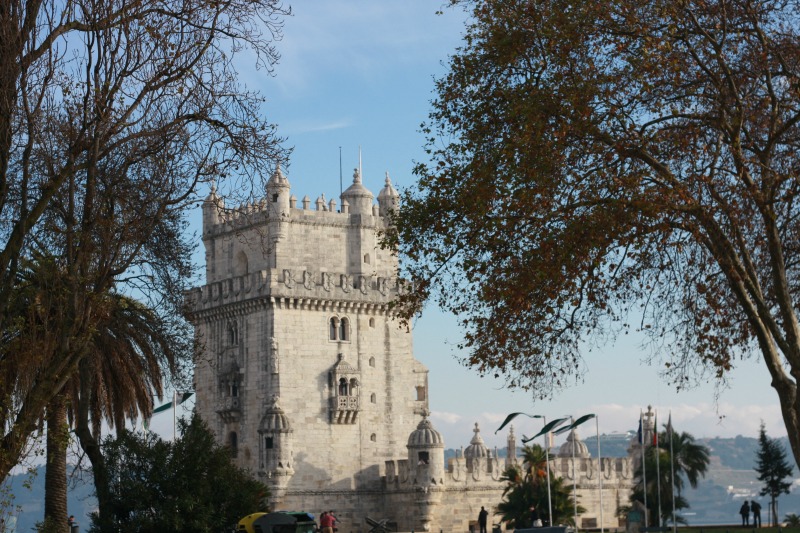
Belém is an historic district on the West part of Lisbon closely related to to the Portuguese discoveries. The emblematic buildings of
Torre de Belém (Belém Tower) and
Mosteiro dos Jerónimos (Jerónimos Monastery), both UNESCO World Heritage sites, were built in Manueline style with exotic, navy and maritime elements inspired by the voyages the Portuguese made around the world.
Between the two monuments one can find the refreshing gardens of Praça do Império, with its fountains and vegetation. Facing the river Tagus you'll have on your right the Centro Cultural de Belém (Belém Cultural Centre), with exhibitions and cultural events and a little further the Champalimaud Foundation, both with a contemporary architecture that is worth to admire.
In walking distance to your left, you'll find the
Padrão dos Descobrimentos (Monument to the Discoveries) and the Museu dos Coches (Coach Museum) where you can find a unique collection of coaches. You can also find the recently opened
MAAT.
While in Belém the choice of restaurants is enormous, and if you don't decide to have lunch or dinner, a visit to the Pastéis de Belém patisserie to taste one (or more) of the worldly famous Portuguese custard pastries is mandatory.
PARQUE DAS NAÇÕES
The
Parque das Nações (Park of Nations) neighborhood, situated in the eastern part of Lisbon, includes the new urban area of the city arisen following the World Expo 1998.
Characterized by its contemporary architecture and the extensive leisure and entertainment facilities, the Parque das Nações quickly won the hearts of Lisbon habitants and the delight of its visitors. Some of the architectural highlights include the outstanding vaults of the Oriente Train Station, by Santiago Calatrava, and the Pavilion of Portugal, by the Portuguese architect Álvaro Siza Vieira.
Among the cultural facilities is worth visiting the Museum of Science and Technology which features several interactive exhibits and the Lisbon Oceanarium, one of the largest aquariums in the world.
Lisbon is a small, beautiful and safe city and you can walk around easily. The subway covers most of the city and is most useful if you want to go across the city. Don’t forget to look to the beautiful pieces of art inside the stations, mostly tile panels and sculptures by Portuguese artists. In some parts of the city the Tram is the perfect choice. Tram 28 for the old town neighbourhoods and Tram 15 to Belém.